By Megan Harris — Laser Specialist, Cool Laser Skin Studio Calgary | Laser Hair Removal for Dark Skin Calgary
If you have a darker skin tone and you’ve been told laser hair removal isn’t for you — or you’ve heard horror stories about burns, blistering, and pigmentation changes — this post is for you.
The short answer is yes, laser hair removal is absolutely safe for dark skin. But the longer answer matters a lot more, because not all lasers are created equal — and the wrong one in the wrong hands can cause real, lasting harm.
As a laser specialist who treats all skin types daily at Cool Laser Skin Studio using the Clarity II by Lutronic, here is what you actually need to know before booking anywhere.
The Most Common Fear — And Why It’s Completely Valid
The number one concern I hear from clients with darker skin tones is: “will this burn my skin?”
That fear is completely valid — because it has happened to real people. Not because laser hair removal is inherently unsafe for dark skin, but because the wrong laser was used, often by an undertrained provider who didn’t fully understand how high-melanin skin responds to heat and light energy.
When a new client comes to me with this concern, I don’t dismiss it. I take the time to explain exactly how different laser technologies work, why some are dangerous for darker skin, and why the one I use was specifically designed with skin types like theirs in mind. That conversation should happen at every clinic, before anyone ever turns a laser on.
Why the Wavelength Is Everything
Laser hair removal works by targeting melanin — the pigment inside the hair follicle. The laser heats the follicle, damages it, and over a series of sessions, permanently reduces its ability to grow hair.
The challenge for darker skin tones is that melanin isn’t only in your hair. It’s in your skin too. If a laser can’t differentiate between the melanin in your hair follicle and the melanin in your skin, it will absorb into both. That is when burns, blistering, and permanent pigmentation damage happen.
This is why wavelength is the single most critical factor when treating darker skin. Here is a breakdown of every major technology and what it means for you:
Nd:YAG 1064nm — The Gold Standard for Dark Skin
The Nd:YAG 1064nm wavelength is the safest and most effective laser for melanin-rich skin types. At 1064nm, the laser penetrates deep into the dermis — bypassing the melanin sitting in the surface layers of the skin and targeting the hair follicle directly. It essentially goes past your skin tone and locks onto the hair.
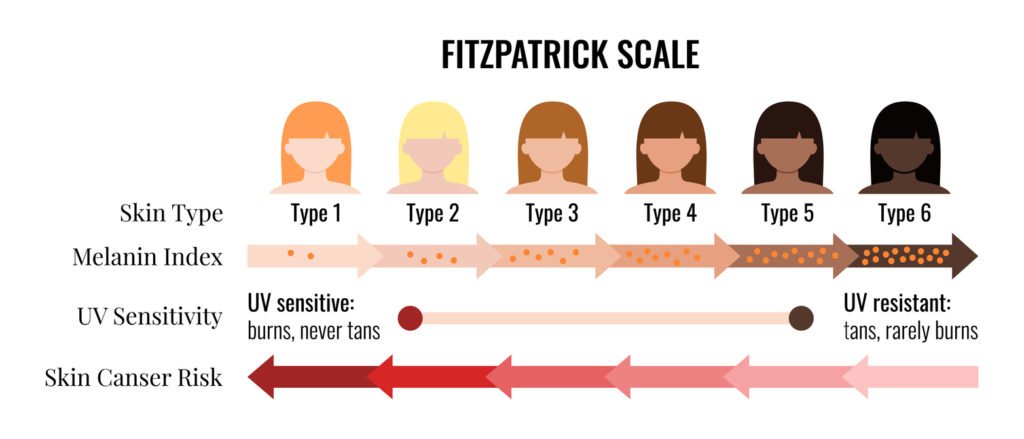
This depth, combined with real-time temperature monitoring and cryogen cooling, is what makes it possible to treat Fitzpatrick skin types IV, V, and VI safely and effectively. The 1064nm Nd:YAG is not a compromise — it is the right tool for the job.
Alexandrite 755nm — Should Never Touch Dark Skin
The Alexandrite laser operates at 755nm, a shallow wavelength whose primary chromophore — meaning its target — is melanin. At this depth, it literally cannot differentiate between the melanin in a dark hair follicle and the melanin in dark skin. It will absorb into both.
This is the laser responsible for the majority of the burns and “polka dot” hypopigmentation cases I have seen clients come in describing. Sometimes it happens because a provider is undertrained. Sometimes it happens because a clinic tries to make the final session “more aggressive” to push results — which is completely backwards when it comes to darker skin. The Alexandrite should never be used on Fitzpatrick skin types IV and above, full stop.
Diode 810nm — High Risk, Small Margin for Error
The diode laser sits at 810nm — deeper than the Alexandrite but still significantly shallower than the Nd:YAG. At low settings, it can be used on some darker skin types, but the margin for error is extremely small.
Here is the way I explain it to clients: think about how the sun heats up darker surfaces more than lighter ones. A dark surface absorbs heat; a lighter surface reflects it. Darker skin responds to laser energy the same way. Even one additional joule of heat can be too much — leading to burns and hypo or hyperpigmentation. The diode can technically treat darker skin at very conservative settings, but it is still a risk, and long-term permanent reduction results are not as reliable as with the Nd:YAG.
IPL (Intense Pulsed Light) 515–585nm — Not Safe, Not Effective
IPL is not a laser at all. It is a broad-spectrum light device that emits multiple wavelengths simultaneously, targeting melanin, water, and hemoglobin all at once. That lack of a single precise target is exactly what makes it dangerous for darker skin.
Operating at 515–585nm, IPL sits at an extremely shallow, superficial level — right where skin melanin lives. On darker skin tones, the device cannot distinguish between the pigment in the hair follicle and the pigment in the surrounding skin. I have seen the results firsthand: blistering burns and permanent hypopigmentation — white patches where the skin’s melanin has been irreversibly destroyed.
Beyond the safety risk, IPL is also simply ineffective for permanent hair removal. It is older technology that may temporarily damage a follicle enough to slow regrowth, but it lacks the precision and depth to permanently destroy it. There is no exact target, no depth control, and no safe calibration for high-melanin skin.
If a clinic is offering IPL for hair removal on darker skin tones, that is a serious red flag — for both your safety and the results you will actually see.
Quick Reference: Laser Safety for Dark Skin
- Nd:YAG 1064nm: Gold standard — safest and most effective for all skin types including IV–VI
- Diode 810nm: High risk — possible at very low settings but small margin for error, less effective long term
- Alexandrite 755nm: Never — chromophore is melanin, cannot differentiate skin vs hair pigment
- IPL 515–585nm: Never — not a laser, superficial, causes blistering and hypopigmentation, not effective for permanent removal
A Real Client Story: Fitzpatrick Type 5, Previous Burn History, Full Body Results
One of the most meaningful client experiences I’ve had involved a Fitzpatrick type 5 client who came in genuinely scared. He had watched people online get burned by lasers at other clinics — and he had done enough research to understand why it happened. He still wanted to be razor-free and done with ingrown hairs and razor bumps for good, but the fear was real and earned.
I walked him through exactly what happened to the burned laser victims. The laser that was used absorbed into their natural skin melanin rather than the hair follicle, because it simply isn’t deep enough to fully bypass the pigment in darker skin. The wavelength picked up on their skin tone, and that’s what burned.
With the Clarity II’s 1064nm Nd:YAG, that risk is removed. The wavelength goes deeper, targets the follicle specifically, and the built-in cryogen cooling system manages heat at the surface throughout every pulse.
We agreed to start conservatively — just his arms — so he could see how his skin responded before committing to anything more. After that first session he told me two things: the laser was not painful at all (the cooling completely changed what he expected laser to feel like), and he could already see a noticeable reduction with zero skin irritation, zero redness, and zero reaction.
By the end of that appointment, he booked his full body.
He completed his full series without a single issue — no burns, no pigmentation changes, no ingrown hairs, no razor bumps. Just smooth skin and a confidence he told me he hadn’t felt in years. That outcome is possible for every dark skin client when the right technology and the right approach are used together.
LASER HAIR REMOVAL FOR DARK SKIN | Calgary
Assessment Consultation
Skin type is more complex than it appears on the surface — literally. A client’s physical appearance might suggest a Fitzpatrick type 3 or 4, but their heritage, genetics, and how their skin actually reacts to sun exposure can tell a completely different story. I’ve had clients who present lighter but whose skin responds like a type 5 or 6. Making assumptions based on appearance alone is how mistakes happen.
This is why every client at my studio completes a detailed skin type intake form before anything else — one that goes well beyond appearance. It asks how your skin responds to sun exposure, whether you tan easily or burn, whether you’ve ever experienced hyperpigmentation, and what your heritage is. That information tells me far more about how your skin will respond to laser energy than looking at you in the room.
From there, my pre-treatment assessment covers:
- Medical history and current medications — recent antibiotics, photosensitizing medications, and certain autoimmune conditions like lupus are contraindications that mean we pause or delay treatment entirely
- Recent sun exposure — heat already sitting in the skin from a recent tan or sunburn makes skin significantly more reactive to laser light. I will not treat recently tanned skin regardless of Fitzpatrick type
- A thorough consultation to review goals, concerns, past laser experiences, and set clear expectations before we proceed
- A test patch for all first-time clients, and especially for darker skin types — a small area treated first to confirm how your specific skin responds before committing to a full session
This process is not optional. It is the foundation of safe, effective treatment for every skin type — and it is what separates clinics that get consistent results from those that don’t.
The Biggest Mistakes Other Clinics Make
In my experience, burns and pigmentation damage on darker skin almost always come down to two things: the wrong wavelength, and a lack of understanding of how high-melanin skin responds to heat and light energy.
The worst cases I’ve seen are people coming with polka dot scarring, blistering, or patches of hypopigmentation — almost always involved an Alexandrite or IPL device being used on a skin type it should never touch, or a diode being pushed at settings that were far too aggressive.
Two scenarios come up repeatedly:
- An undertrained provider who doesn’t understand melanin absorption and uses whatever device they have regardless of skin type
- A provider who decides to make the final session “more aggressive” to accelerate results — which is exactly the wrong approach for darker skin. More energy does not mean better results. It means a higher risk of thermal damage on skin that already absorbs more heat than lighter tones
If you have experienced a burn or pigmentation change from laser treatment in the past, it was almost certainly a technology or training problem — not a problem with your skin.
“I Was Told I Can’t Be Treated” — Here’s What That Actually Means
If another clinic turned you away, the most likely reason is that their specific technology — an Alexandrite, IPL, or high-setting diode — genuinely cannot safely treat your skin tone. And that is actually the responsible call for them to make. A clinic that tells you “our laser isn’t right for your skin type” is being honest. The ones to be concerned about are the clinics that take you anyway and treat you at ineffective or unsafe settings because they don’t want to lose the booking.
At Cool Laser Skin Studio, every skin type is treatable and can achieve real, permanent results with the Clarity II’s 1064nm Nd:YAG. The technology was designed with skin types like yours in mind — not as an afterthought, but as a primary design goal.
If you were turned away for a medical reason, it is worth speaking to your doctor for clarification. Some contraindications are temporary — a course of antibiotics, a recent medication change — and once resolved, treatment becomes a safe option. We can also discuss this at your consultation and point you in the right direction.
The Bottom Line
Laser hair removal is safe for dark skin — when the right laser is used, by someone who genuinely understands how melanin-rich skin responds to heat, at settings that are calibrated carefully for your specific skin type.
The Nd:YAG 1064nm is the gold standard for a reason. The depth, the precision, and a wavelength that works with your skin instead of against it makes all the difference between a transformative result and a damaging one.
You deserve to be razor-free. You deserve smooth skin without ingrowns, bumps, or the anxiety of wondering if each shave will cause irritation. And you deserve a provider who takes the time to understand your skin before they treat it.
If you’ve been curious but hesitant, a free consultation is the best place to start. We’ll go through your skin type, your history, your concerns, and give you an honest assessment before anything else happens.
Ready to find out if you’re a candidate? Visit our laser hair removal in Calgary page to learn more about our treatments and book your free consultation.